Tuscaloosa Plans Downtown Statue & Plaza Honoring Namesake Native Chief
Officials in Tuscaloosa are planning a massive, 22-foot statue and decorative plaza to honor the Native American chief for whom the city is named.
Supporting documents attached to agendas uploaded ahead of Tuesday's city council meetings show a proposal to enter into a professional services contract with Caleb O’Connor to create a statue of Chief Tushkalusa as part of "Project Warrior" for $462,641.
The sculptor is the same maker responsible for a few other signature public artworks in town, including the statue of Deontay Wilder on the Tuscaloosa Riverwalk and the just-installed Marshall Four at the Benjamin Barnes YMCA.

The committee will also hear a proposal to contract with TTL Civil Engineering to design and build the site around the statue for $162,100.
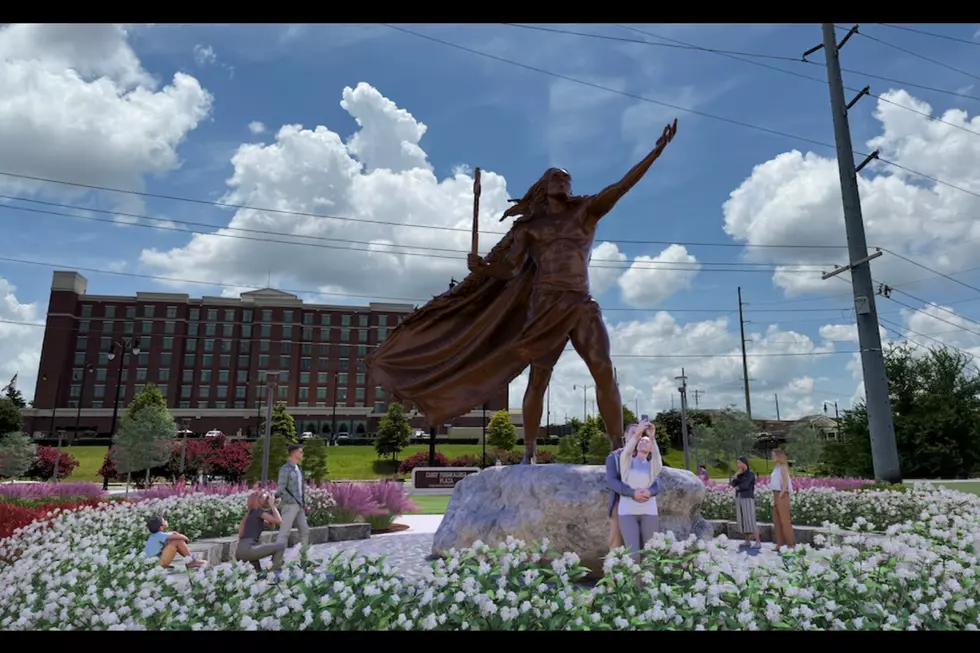
Renderings show a small circular plaza ending with a statue of Chief Tushkalusa overlooking the river, which, like the city, is named after the native leader. The elements of his name in Muskogean, Tushka and Lusa, translate to 'Black Warrior,' according to Tuscaloosa County Sheriff's Chief Deputy Loyd Baker, who has been on a three-year mission to learn more about the native leader and his appearance.

The new decorative space would be another major improvement for downtown, planned for an empty lot on Greensboro Avenue between the Embassy Suites hotel, River District Park, and the Mercedes-Benz Amphitheater, in the shadow of the under-construction Saban Center. A city spokesperson said walking paths will connect the new plaza to the Saban Center and Western Riverwalk.
"The Chief Tuskaloosa Plaza is a collaborative project between the City of Tuscaloosa, Tuscaloosa County, The University of Alabama, Visit Tuscaloosa, and the Alabama Tourism Department," the spokesperson said. "This public space honoring the legacy of Tuscaloosa’s namesake and one of our region’s most significant historical figures will feature a 22-foot-tall bronze statue of Chief Tuskaloosa, created by nationally renowned artist Caleb O’Connor. Throughout the space, educational storyboards will highlight the life and leadership of Chief Tuskaloosa, and the enduring contributions of Indigenous peoples to our region."
They said the initiative is also supported by the 2025–2026 Leadership Tuscaloosa class of the West Alabama Chamber of Commerce, which has adopted the project as a civic engagement effort.
The project, which has been in planning stages for most of this year, is being championed by District 4 City Councilman Lee Busby, who represents the downtown area.
Visit Tuscaloosa President Kelsey Rush said she's excited to see this dream become reality, acknowledging the area's history and drawing people to see it and learn more.

“Public art is a powerful tool for storytelling. It allows us to share Tuscaloosa’s rich history in ways that resonate with residents and visitors alike, and Visit Tuscaloosa is proud to partner with the City of Tuscaloosa and others on this monumental public art initiative," Rush said. "This effort will further educate people about our city’s namesake with the most historically accurate depiction of Chief Tushkalusa and create a meaningful connection to our past while enhancing our sense of place. Together, we are committed to preserving and celebrating Tuscaloosa’s heritage.”
Chief Tushkalusa died almost 500 years ago, but was a legendary leader of a large group of Native Americans who were the ancestors of the Choctaw and Creek tribes that later lived across Alabama.
The Chiefdoms were invaded by the Spanish conquistador Hernando de Soto in 1540, and the natives' refusal to provide him with slave laborers and women led to a brutal battle with Chief Tushkalusa and his warriors at a still undiscovered site called Mabila, a fortified native city.
The few hundred Spaniards were dramatically outnumbered, but what they lacked in manpower they more than made up for with metal armor, steel weapons, and early firearms.
Though Mabila was burned and the Chief is thought to have been killed along with thousands of other native Americans, the battle cost de Soto deeply. When he died two years later, the remaining Spanish troops left what would become America and ended up in friendly territory in Mexico.
TCSO Chief Deputy Baker said the statue will be as true to history as possible, almost 500 years after the bloody battle and Tushkalusa's death.
"We have gone to great lengths to depict Tushkalusa as historically and culturally accurate as possible," Baker told the Thread. "We drew on the eyewitness accounts of De Soto’s men for as much as we could. Then we contacted the Choctaw and Chickasaw nations in Oklahoma to fill in the blanks for what De Soto didn't describe."
Though a statue of the Chief commissioned by the McAbee family is already on display within the Tuscaloosa Public Library, the fixture proposed in Project Warrior would be far more prominent.
For more coverage of the $625,000 project to recognize the legendary native chief for whom the river and city are both named, stay connected to the Tuscaloosa Thread.
Top Stories from the Tuscaloosa Thread (11/24 - 12/1)
Gallery Credit: (Stephen Dethrage | Tuscaloosa Thread)
More From Tuscaloosa Thread