10 Witnesses Testify in Emotional Sentencing Hearing to Decide if Watkins Will Die
The same jury that convicted Luther Watkins Jr. of capital murder last Friday heard from ten witnesses during the first day of a sentencing hearing to determine if the 26-year-old will be executed or spend life in prison.
As the Thread reported last week, after alternate jurors were dismissed, there are six white women, three white men, two black women and one black man serving on the 12-person jury.
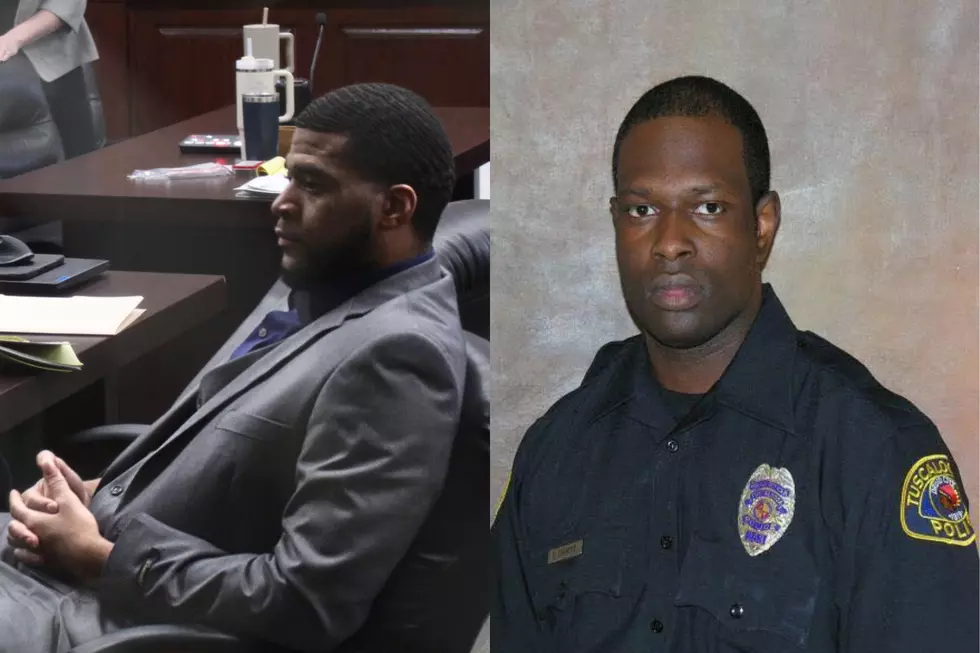
On Friday, they convicted Watkins of the capital murder of a law enforcement officer, Tuscaloosa Police Investigator Dornell Cousette, in a September 2019 gunfight. The only sentencing outcomes available for that charge are life in prison without the possibility of parole or the death penalty.

After taking the weekend and President's Day off, the jury was back at the Tuscaloosa County Courthouse on Tuesday in the courtroom of now-retired Circuit Judge Brad Almond for sentencing to begin.
Almond explained to jurors that the sentencing phase is a lot like the trial - the state and defense teams present their opening arguments, call witnesses to testify under oath, and then make closing statements. The jury then deliberates in private and emerges with a decision.
Almost all witness testimony came on Tuesday morning and afternoon. The State called five witnesses to testify about their relationships with Investigator Cousette, and the defense called five family members or friends of Luther Watkins to plead for mercy on his behalf.
Paula Whitley Abernathy for the State
As with the trial, the state presented its case first. In opening arguments, lead prosecutor Paula Whitley-Abernathy asked the jury to put aside sympathy and emotion, apply the law, and sentence Watkins to die.
She said the murder of Dornell Cousette or any other law enforcement officer does not qualify as capital murder because police officers are somehow superior human beings, but rather because of their role in keeping a community safe. By serving warrants, investigating crimes, protecting schoolchildren, and more, she said, Cousette was making Tuscaloosa a more civilized place.
"When they are killed while protecting us, they have made the ultimate sacrifice," she said. "That makes this killing the worst of the worst, and it deserves the death penalty."
Justin Forrester for the Defense
Defense attorney Justin Forrester said Watkins was a wayward youth with few positive influences who made a terrible decision when he was a month over 20 years old, and he does not deserve to be executed by the state for it.
They promised an unflinching view into Watkins' family life, where he was the youngest of five children, all born before his mother turned 22, and was partially raised by a young uncle who lived a life of crime.
"We can be sad and sympathetic to the trauma Cousette and his family went through, but that is not mutually exclusive to being sad and sympathetic for Luther," Forrester said. "Mercy and sympathy are rational, human, and allowed here."
Five Witnesses Testify About Cousette in Support of Execution
The state called five witnesses to talk about Dornell Cousette, his role at the Tuscaloosa Police Department, and at the Tuscaloosa Career and Technology Academy, where Cousette often worked as a school resource officer.
The first on the stand was Jason McKee, a Tuscaloosa Police Investigator specializing in robbery who also had a stint on the multi-agency Violent Crimes Unit.
McKee testified to issuing a BOLO alert for Watkins in September 2019, advising all sworn officers in Tuscaloosa, "from the chief down," to be on the lookout for the 20-year-old.
Henry McCaskill testified next - he was Cousette's supervisor in the Youth Aid Division at the Tuscaloosa Police Department. He said Cousette and many others began working as school resource officers after the massacre at Marjory Stoneman Douglas High School in Parkland, Florida.
McCaskill was emotional as he described seeing Cousette die at DCH Regional Medical Center, cleaning out his desk, and carrying his casket.
Cathy Wood, the former director of the Tuscaloosa County Juvenile Detention Center, recalled Cousette for how he cared about all parties involved in juvenile crimes - suspects and victims alike.
Like every other witness for the state, Wood said Cousette went above and beyond in his work for children and families in the community.
Ebony Johnson, the executive director at the Tuscaloosa Children's Center, worked with Cousette on their Multi-Disciplinary Team to work towards good outcomes for kids who were often the victims of abuse, neglect, sexual violence, and more. She said his absence left a void at TPD and in every organization he was involved with.
Lastly, the jury heard from Kelly Cousette Mills, Dornell's first cousin. She described growing up with him and his three brothers and called him silly but loyal - someone she and others could count on to do the right thing and protect them.
The defense did not cross-examine any of the state's witnesses, and the prosecutors rested after calling those five to the stand.
Luther Watkins Mother, Uncle & Others Make Case for Life Imprisonment
Many on the left side of the courtroom shed tears during testimony from the friends and family of Luther Watkins as they pleaded with the jury not to sentence him to death.
The first witness was Tiffany Collins, Luther's mother, who testified that she was the victim of molestation and gave birth to her first son in 1992, when she was just 14. When she met Luther Watkins, Sr., and together they had Luther Watkins, Jr., he became her fifth child, though Collins was only 22.
Collins described a tight-knit family in which her own mother and her brother, Marcus, were heavily involved in raising her five kids while Collins stayed working at Denny's, Taco Casa, Wendy's, and CVS on the way to becoming a phlebotomist who draws blood at local medical facilities.
She said Watkins, Sr. was a good father for the first few years of their son's life, before things got rough and the family moved around while Collins and the older Watkins went through separation and divorce.
While Collins tried her best, her brother, Marcus, was often left to watch Luther and the other kids, and he testified on Tuesday to frequently exposing them to drugs, alcohol, guns, and other parts of his life of crime.
Luther Watkins Jr.'s oldest brother, Deontay Collins, talked about helping raise him and trying to be a positive role model in their childhood, but said he left Tuscaloosa to enlist in the Army, following his grandmother's example.
When he returned after two years in Georgia, Mississippi, and Alaska, he found his baby brother was on a different path than when he left.
Linda Harper, the former principal of Tuscaloosa's STARS Academy, testified about getting to know Luther Watkins Jr. during his time in an alternative school.
Clashes in public schools landed him at STARS, but Harper said he was a brilliant and respectful student who was poorly served by the system's disciplinary procedures.
She described Watkins taking their robotics team and, in the 7th grade, leading high schoolers on the team to second place at a competition on the University of Alabama campus.
She said the last time she saw Watkins, it was after he'd been moved from STARS back to Northridge High School, where he'd had another disciplinary infraction and was waiting for a hearing about what would happen to him. She told him to keep his head up - that she was going to be the first engineer to come from the Academy.
Pastor William McDowell, Sr. from Liberty Missionary Baptist Church, testified to knowing both Collins and Watkins for their entire lives. He said despite working with District Attorney Hays Webb and acting Tuscaloosa Police Chief "Sebo" Sanders on community initiatives, he felt compelled to come plead for Watkins' life on Tuesday.
The last and most emotional testimony came from Watkins's uncle, Marcus Collins, who testified despite having active warrants for his arrest on Tuesday.
Collins said he'd been arrested at least 50 times, and said he was a terrible influence on Luther Watkins, Jr. during his adolescence. He said he was barely a man himself when his sister's fifth child was born and didn't understand how important it was to be a better example.
Instead, Collins said he exposed his nephew to alcohol, drugs, and guns. He even told the jury that he once fled from a police stop with a young Luther in the car beside him.
"He's collateral damage," Collins said through tears. "He didn't have a fucking chance."
"Without my influence, he would have been a robotics engineer or a soldier," he continued. "He could have been anything."
Before testimony concluded, Collins urged the jury to spare Watkins' life and understand that life in prison without the possibility of parole is no lenient sentence and will allow the still-young man to see 30, 40, and 50 - to better understand the weight of his mistakes as he ages.
"He was just a child who made impulsive decisions based on bad grooming," Collins said, then left the stand and apologized to Luther Watkins, Jr. before exiting the courtroom.
Jury Breaks Until Thursday
The defense still has at least one witness to call, and Judge Brad Almond said they were not available Tuesday and that he had a conflict on Wednesday. The jury will reassemble on Thursday morning to hear that testimony, hear closing arguments, and begin deliberations about whether Watkins will face life in prison or death.
District Attorney Hays Webb told the Thread he has not sought the death penalty since 2019 after the trial of Michael Belcher, who was convicted of the brutal torture, murder, and decapitation of Samantha Payne. Belcher was condemned to die, and an appeals court upheld that decision last year.
For coverage of that decision and other news in West Alabama, stay connected to the Tuscaloosa Thread.
Top Stories from the Tuscaloosa Thread (2/9 - 2/16)
More From Tuscaloosa Thread