
Remembering Alabama’s April 27, 2011 Tornado Outbreak
Every generation has a date that will live in memory for those who experienced it, such as Dec. 7, 1941 – Pearl Harbor, Nov. 22, 1963- the Kennedy Assassination, Sept. 11, 2001 – the New York/Washington terror attacks, and April 27, 2011 - the "Super Tornado Outbreak". It was one of those days that you remember where you were, what you were doing and if you were impacted, that experience is relived every time there is a storm.
Today marks the 15th anniversary of one of the deadliest outbreaks of tornadoes across the south in one day - 292 in 16 states. Among them 62 confirmed tornadoes struck Alabama, marking a historic and deadly peak of a four-day 362 twister outbreak.
The "Heads-up"
Seven days before the outbreak the National Weather Service in Birmingham issued repeated ominous heads-up characterized as a "red letter" day for long track supercell tornadoes. These advance alerts prompted many businesses and schools to close, which likely saved countless lives.
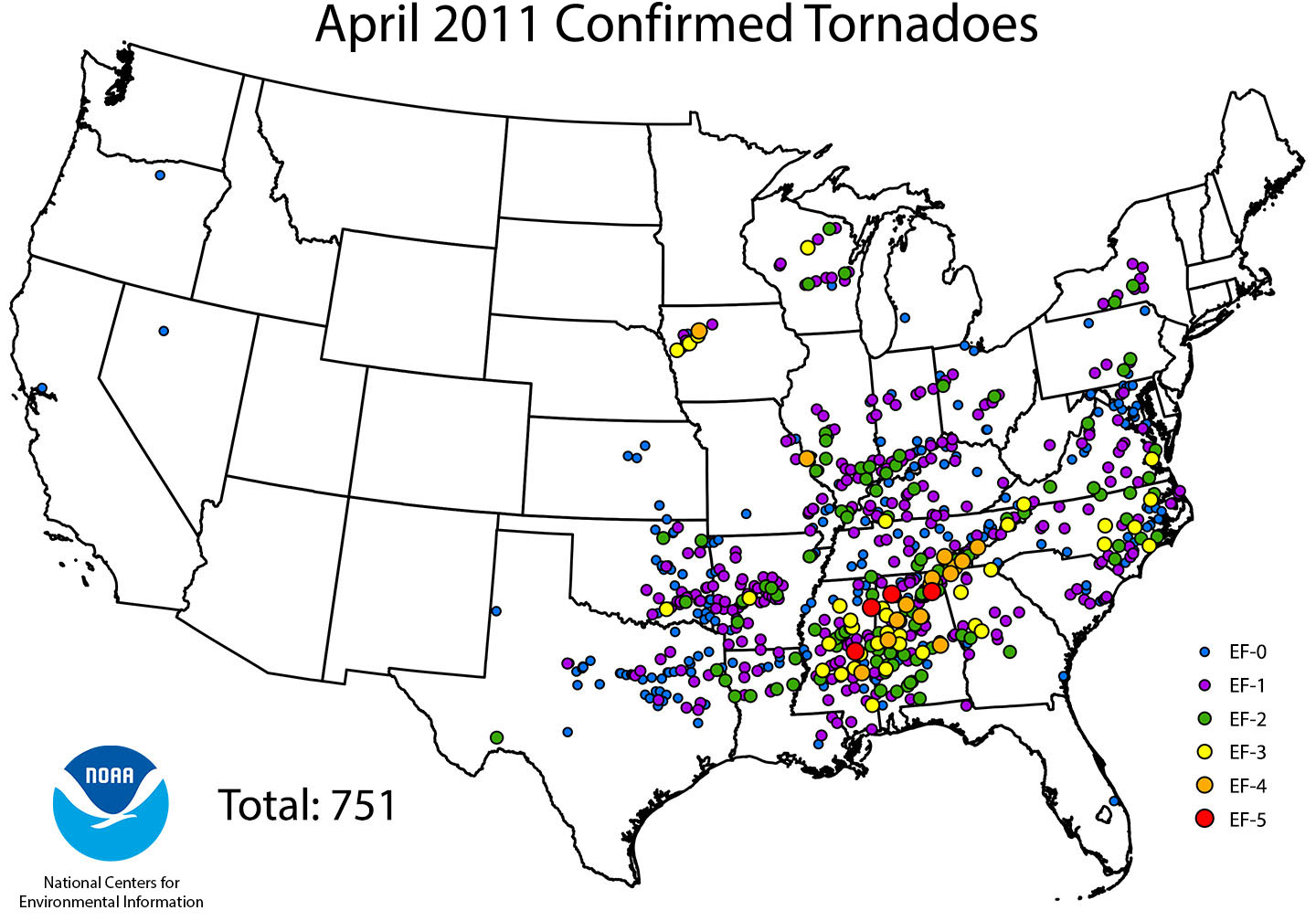
The outbreak was caused by a vigorous upper-level trough that moved into the Southern Plains states on April 25. As the system moved eastward it spawned severe weather event after severe weather event from Texas to the east coast. In all there were 751 tornadoes detected in April 2011 according to National Weather Service studies.
The Impact
Over 200 people were killed in Alabama alone April 27th. The outbreak included multiple EF-4 and EF-5 tornadoes, most notably the Tuscaloosa-Birmingham, Hackleburg-Phil Campbell, and Hale County tornadoes.
The day set the record for the most tornadoes in Alabama in a single day with the Tuscaloosa-Birmingham twister being the most massive. At its peak, this EF-4 was 1.5 miles—more than 26 football fields—wide, and its winds reached 190 mph. It travelled 80.3 miles but the supercell that spawned it stayed together into Georgia where it dropped another funnel in Rabun County just before midnight.
This writer was one of those directly involved. Serving as a Division Coordinator with the Alabama Emergency Management Agency (EOC), I was in the first significant building destroyed by the Tuscaloosa EF-4, the Curry Building in Kaulton that housed the Tuscaloosa County Emergency Operations Center.
It took a while for those of us inside to get out of the rubble, finding our vehicles destroyed we had to make our way to the nearby Tuscaloosa Police Headquarters. If the City of Tuscaloosa had not had a functioning command center in the basement of city hall that day, the response to the disaster would have been severely hampered.
The plan to establish a back-up county EOC in the University of Alabama's Emergency Operations Center, then located at Bryant-Denny Stadium, was activated and representatives of response agencies worked out of there for week.
"Fortunately, although we lost 17% of our assets, we had a lot of other assets in place," remembered Tuscaloosa Mayor Walt Maddox. "We were quickly supported by the Alabama National Guard and 37 different municipalities and county governments that came to our rescue. most notably UAPD and the City of Northport. Those assets were critical for us in those first 48 hours as we began to build back the pieces of what we had lost in turns of our response mechanisms during the tornado."
Maddox's greatest memory of the day's events was how inspiring the response of the people was. "What I saw was people in the streets searching for the missing, transporting the injured to the hospital and putting the needs of their neighbors first."
The remarkable recovery since April 27th is seen as a model for how a city should recover from a natural disaster.
West Alabama Hit Hard
Tuscaloosa was not the only city to suffer massive destruction that day in West Alabama. Marion, Franklin and Walker and Hale Counties experienced significant damage, injuries and loss of life.
The town of Cordova was struck by an EF-3 early and again late on the 27th by EF-4 tornadoes, resulting in 54 injuries and 13 deaths. Since, the city has opened a new police station city hall and Piggly Wiggly store but 15 years later the rebuilding is still underway.
An Ef-5 with winds to 200 mph raked 25 miles across Marion County leaving behind 18 fatalities and 200 injuries in Hackleburg. Several subdivisions, businesses, schools and the Wrangler Plant were destroyed.
The same twister that roared through Hackleburg also hit Phil Campbell. The violent EF5 tornado ripped through Franklin County, killing 27 people and destroying 937 structures in its path. A total of 430 of those homes and buildings were in the Phil Campbell city limits. Of those, 85% sustained major damage or were decimated.
Phil Campbell City Councilwoman Lynn Landers says the storm damaged the city in more ways that destroyed buildings, "We lost a lot of citizens when they moved out of town. They either lost their homes, or we had no homes left to offer."
A tornado rated as an EF-3 with 145mph winds sliced across Greene, Hale and Bibb Counties.
Two people received minor injuries in Greene County before the storm with a 72-mile-long path crossed into Hale County.
In Hale County, Emergency Management Director Russell Weeden has a dominant memory from the EF-3 tornado that tracked across Sawyerville. "A lot of devastation," he remembered, "we ended up transporting 42 patients and we had eight fatalities. It was hard to manage the response because there was just so much devastation."
The twister did not lift up until after it struck the Bibb County Town of Eoline. The Eoline Fire Dept and another business were destroyed; there was one fatality and 10 injuries.
Lessons Learned
Dr. Patrick “Shane” Crawford was a student at the university on April 27, 2011. Now he is an assistant professor in the Department of Civil Engineering, where he studies how communities and infrastructure respond to natural disasters. He is working to take lessons learned from April 27 and other past disasters and turn them into solutions that protect people in the future.
One of the lessons learned from April 27th and other outbreaks is there are too many substandard site-built homes and mobile homes. "Historically, engineers were never required to design buildings for tornadoes, but in recent years that has changed due to new science provided by tornado researchers," Crawford stated in a UA press release.
Among other lessons learned was the need to have multiple ways of receiving warnings, providing funding for more individual and community storm shelters and developing more robust county emergency management agencies.
Spring 2026 has been a quiet severe weather season so far, but we are in April, the peak of the season, with May still to go. Remembering what happened 15 years ago today should provide the impetus to make sure we are prepared for the next severe weather outbreak.
More From Tuscaloosa Thread