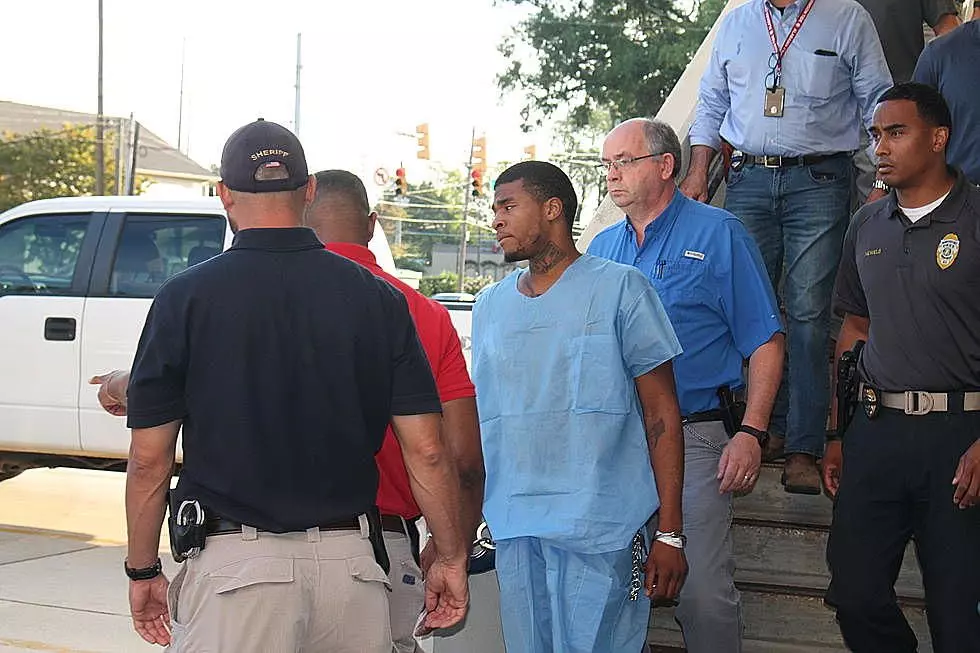
Jury Learns of Alleged Criminal History in Luther Watkins Murder Trial
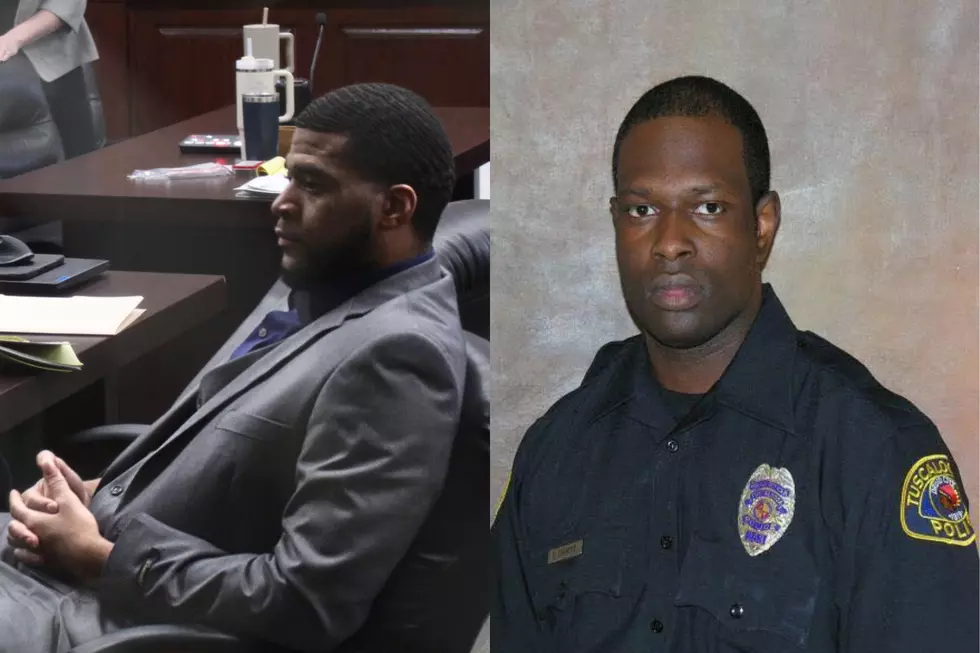
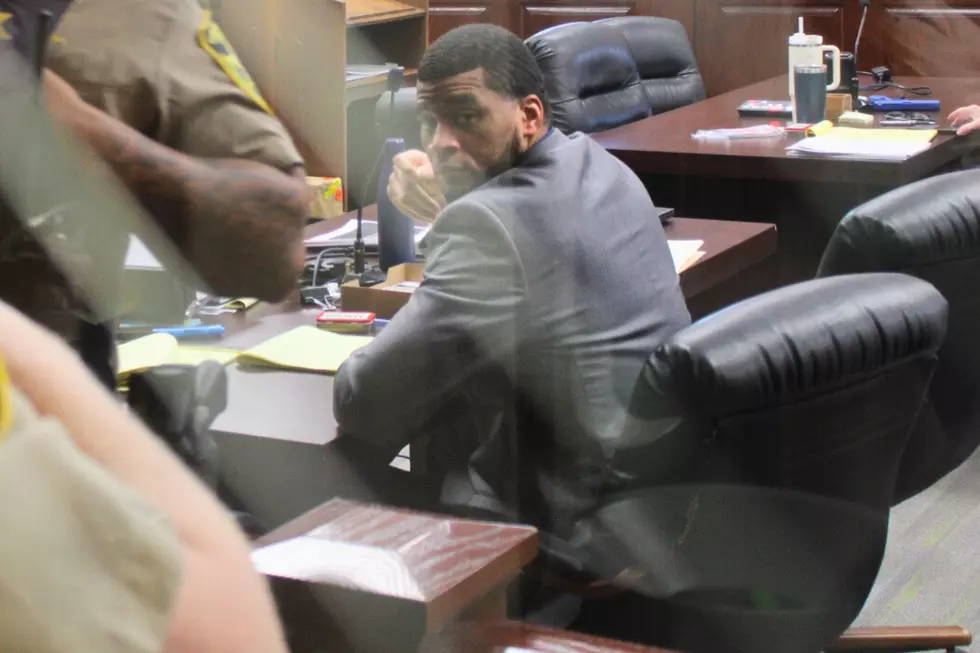
Jurors learned that Luther Watkins was wanted in connection with many violent crimes when he shot and killed a Tuscaloosa Police investigator in 2019, as his trial continued on Tuesday morning.
Many witnesses called by prosecutors on Monday testified about September 16th, 2019, the night TPD's Dornell Cousette and a local bailbondsman tracked Watkins to a home in West Tuscaloosa.
Without backup and to the bondsman's surprise, Cousette chased a fleeing Watkins inside the house, despite agreeing to only drive by the home. Within moments inside the home, Cousette fired two shots, striking Watkins in his back and again in the shoulder. Watkins, then 20, fired a single shot and hit Cousette in the head.
Tuesday began with the defense's cross-examination of Tuscaloosa County Sheriff's Office crime scene analyst David Hanks, so we'll continue our chronological coverage of the trial with his testimony.
No electronic devices are being allowed inside Judge Brad Almond's courtroom for the duration of the trial, so the reporting below is done without the benefit of a transcript.
READ MORE: Catch up on extensive coverage of the case and trial so far at this landing page.

CSI Analyst David Hanks
Deputy David Hanks testified that he extensively photographed the 2019 crime scene and collected physical evidence, including three spent shell casings and Cousette's 9-millimeter Glock 17 service weapon, but not Watkins' firearm.
The jury saw photographs, including a large pool of blood under Cousette's removed body armor and a tooth fragment the Investigator lost when he was shot in the upper lip.
Hanks also showed physical evidence to the jury, opening sealed boxes and envelopes and displaying Cousette's Glock and the spent casings to the courtroom in person.
Defense attorney Justin Forrester cross-examined Hanks on Tuesday morning and noted that officers removed Cousette's gun from the actual crime scene and secured it in a vehicle before Hanks arrived. Forrester questioned whether that might be considered evidence tampering.
Forrester also had Hanks review more than 70 crime scene photos and asked him questions about them. He noted that although Cousette had a number of case files in his Ford Taurus, none were related to Watkins.
The defense also spent time asking Hanks about a Taser belonging to bondsman Ed Giles, which was photographed on the scene but not collected as evidence.
Giles did not fire the less-lethal Taser X26 on the night of the fatal shooting.
Tuscaloosa Police Patrol Sergeant J.C. Bryant
The state's eighth witness in this trial was Tuscaloosa Police patrol Sergeant J.C. Bryant.
In a very brief testimony on Tuesday morning, Bryant said he was called to respond to DCH's Northport Medical Center the night of the shooting after police learned that Watkins had been dropped off there for medical care.
Bryant testified that upon arrival, someone told him that some items had been scattered around the hospital parking lot at about the time Watkins arrived. Bryant said he reviewed security footage and watched Watkins drop several small items as he approached the hospital, wrapped mostly in a sheet.
The jury saw that footage, and as reported yesterday, a friend of Watkins dropped him far away from the emergency room door over fears of getting wrapped up with the police over his wounds.
On film, Watkins can be seen walking under his own power and dropping several items from a fanny pack he was wearing.
Bryant testified that the items were five individual 9-millimeter bullets and two pieces of jewelry.
In cross-examination, the defense briefly inquired about the chain of custody after an investigator collected the evidence, but did not delve deeply, and Bryant was dismissed.
Crime Analyst Robert Alexander
Some of the shortest testimony of the morning came from crime analyst Robert Alexander, who explained to the jury that any call an inmate makes from within the county jail is recorded and retained for at least two years in case it has evidentiary value.
Alexander introduced the jury to the idea of recorded jail calls, but it was the state's next witness, Lieutenant Michael Hall, who would testify about specific calls in this case.
Lieutenant Michael Hall
Hall was the state's tenth witness in the trial and said in 2019, he was a sergeant working in the multi-agency Tuscaloosa Violent Crimes Unit and helped investigate Cousette's death.
He photographed Luther Watkins at UAB Medical Center being treated for the gunshot wounds he suffered in the gunfight with Cousette, and the jury saw those pictures on Tuesday.
He also spent a long time discussing posts and Messages from Watkins's Facebook account, which had been certified by the social media network as authentic.
Prosecutors showed several pictures of Luther Watkins posing with various firearms and money and read scary-sounding captions.
One such message was "I just caught another case, I'm a young felon. If a n***a in my way, I'm gon' crack his melon."
Hall testified that this sounded like an acknowledgement of crimes committed and a threat. In cross-examination, defense attorney Chris Daniel pointed out they're the lyrics to a song by Kodak Black, an American rapper.
Watkins' Facebook activity also served as the means by which the State disclosed his juvenile criminal history to the jury.
Judge Brad Almond had previously ruled that prosecutors could not mention the details of the felony warrants out for Watkins at the time of the shooting because they were considered juvenile matters and inadmissible in other courts.
On Tuesday, though, Chief Assistant District Attorney Paula Whitley Abernathy revealed that friends had twice messaged Watkins on the social network, sharing screenshots of the Tuscaloosa County Sheriff's Office mobile app or website listing the warrants against him.
Because the information was coming from a different, allowable channel, Almond permitted the state to show those messages to the jury.
Jurors learned Watkins was wanted for four counts of first-degree armed robbery and one count of felony second-degree assault in September 2019 when Cousette came after him.
Defense attorneys noted that Watkins had never been convicted on those charges and should be considered innocent until proven guilty. Judge Almond instructed the jury not to allow testimony about the robbery and assault charges to influence their thinking about the facts of the murder trial.
Still, the defense had fought to keep the details of the charges out of the trial and, because of the Facebook evidence, the prosecution won that battle Tuesday, sharing the information with jurors.
With Hall still on the stand, the jury also heard a recording of a call Watkins made from the Tuscaloosa County Jail after he was booked there and charged with capital murder in the wake of Cousette's killing.
On the phone, Watkins can be heard asking what witnesses on the scene may have told police, instructing people to put up "No Trespassing" signs at the crime scene and giving coded instructions on where to find his "stick," which investigators said meant his gun.
On the call, he asks for money in his jail commissary account and, at one point, denies being present when Cousette was killed, claiming he was already at the hospital in DCH when everything went down.
In a cross-examination, the defense asked Hall about police training and whether he'd ever shot someone in the back, or fired a weapon inside a house without knowing who was inside.
Hall said no, but in a redirect from Whitley Abernathy, he strongly defended Cousette's decisions.
Given the nature of the charges against him in 2019, Hall testified he would have considered it "a failure of your duty," to see Watkins in public and not attempt to arrest him.
Captain Marcus Bell
The state's eleventh witness was Tuscaloosa County Sheriff's Office Captain Marcus Bell, who currently oversees the county jail. In 2019, he was an investigator with the VCU, and he testified about his work in that capacity on Tuesday.
After Cousette was shot and rushed to DCH Regional Medical Center, Bell said he drove to the hospital and stayed with the TPD investigator until he died.
The TCSO employee then removed and catalogued Cousette's clothes and boots and placed him in a body bag for eventual transport to the Alabama Department of Forensic Sciences for autopsy.
Bell also testified that Hall reached out to him to ask what a "stick" was after listening to Watkins' jail call, and that Bell recognized it to mean a firearm. With details from the call, Bell said he raced over to the home of Kenclomisha Hughes, the woman who drove Watkins to the hospital in Northport.
There, he testified, Bell found Watkins' Hi-Point 9-millimeter handgun in a toolbox in the backyard. A different investigator came to collect it.
Bell opened an evidence box containing the weapon and showed it to the jury, along with a handful of bullets and two casings from bullets fired at a lab in Montgomery as samples.
Dominique Thomas, Dexter Lewis & Nannie Chambers
The final three State witnesses before the trial adjourned for the day on Tuesday were all present at the West Tuscaloosa house where the shooting took place in 2019.
First on the stand was Dominique Thomas, who said the house belongs to his grandmother, Nannie Chambers.
He testified that Chambers' sister, his great aunt, had died of dementia on September 16th, 2019, and many people were gathering at the house that day to celebrate her life and mourn her death.
Thomas said he was getting ready to cook on a charcoal grill on the front porch, while four young men, friends or family, played cards at the table nearby.
They were Luther Watkins Jr., Dexter Lewis, Kevonte Chambers and Keric Taylor.
Inside, Nannie Chambers said she was charging her phone, and her daughter Felicia Chambers was asleep on the living room couch with a baby in her arms.
Thomas and Lewis, who were outside, testified to seeing Cousette and bondsman Ed Giles arrive on the scene. They said Watkins ran inside immediately, Cousette chased him within, and almost instantly, gunshots rang out.
Neither of the men nor Nannie Chambers saw the shooting happen. They also testified that they never heard Cousette threaten Watkins, nor did they hear Watkins threaten Cousette.
Thomas and Lewis testified they'd seen Watkins with a concealed gun that day, but that was not unusual, and he had not drawn it when he ran inside out of their sight.
A few more witnesses remain for the prosecution, and they will be called to the stand on Wednesday morning. If things move quickly, the prosecution could rest its case tomorrow, and the defense attorneys will begin calling their own witnesses.
For ongoing daily coverage of the murder trial and other crime and courts news from around West Alabama, stay connected to the Tuscaloosa Thread.
Top Stories from the Tuscaloosa Thread (1/26 - 2/2)
Gallery Credit: (Stephen Dethrage | Tuscaloosa Thread)
More From Tuscaloosa Thread